Rebirth Through Fire: The Sacred Discipline of Conscious Inner Transformation
(Based on the live discourse of Param Dwij)
(परम द्विज के प्रवचन पर आधारित)

Param Dwij says:
“A true Dwij is not one who has changed their life, but one who has changed their relationship with truth.”
There comes a moment in every seeker’s life when the world around them no longer reflects the world within. The job feels hollow. The relationships feel heavy. The habits that once numbed now hurt. The story they’ve told themselves begins to crack. That crack, painful and terrifying as it is, is not the end. It’s the invitation.
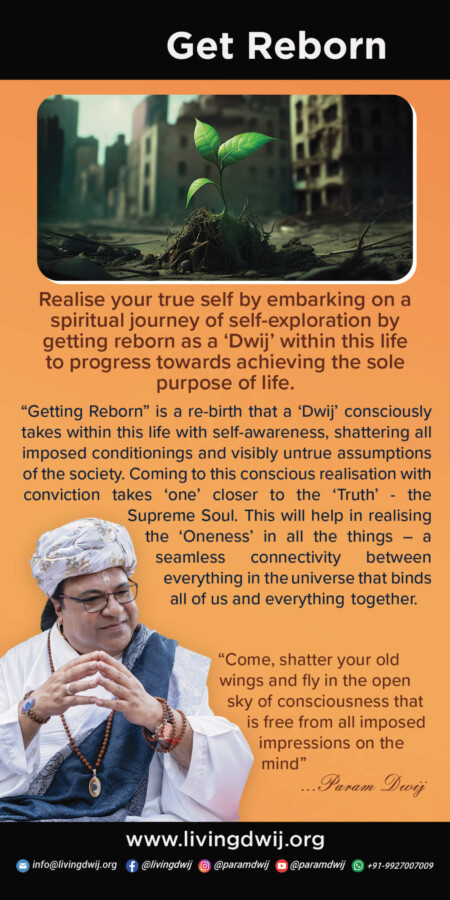
The Living Dwij path refers to this moment as the Agni Antah Sankalp—the inner resolve to walk through the fire. Not to be burnt. But to be reborn. This blog delves into the advanced terrain of conscious inner transformation, not as a spiritual escape, but as a sacred discipline. On this path, we willingly dismantle the false self to reveal the truth beneath.
Part I: The Myth of Sudden Awakening
Most of us imagine awakening as a lightning bolt—a single moment that changes everything. But fundamental transformation is not sudden. It is slow. Layered. Cyclical. Often agonising.
Param Dwij says:
“You will not wake up one morning and be free. You will wake up one thousand mornings and choose freedom again.”
This is why the Dwij path speaks of rebirth—not as a one-time enlightenment, but as a daily return to presence, to humility, to fire. The first death is not the physical one. It is the death of illusion. The moment we admit that we’ve been living in roles, masks, and projections. That everything we used to chase no longer brings peace. From this death, a new life begins.
Part II: The Three Fires of Inner Rebirth
In the Living Dwij path, transformation moves through three inner fires:
1. Agnisanchay (The Fire of Purification)
This fire burns away the unnecessary. Habits, identities, and attachments that no longer serve your soul. It is the season of grief. Of letting go. You might find yourself weeping without knowing why. You might feel distant from friends, overwhelmed by silence, and confused about your purpose. That is not regression. It is released.
Param Dwij says:
“When the old leaves fall, the tree does not panic. It knows: the soil is being readied for spring.”
This is a sacred phase. Don’t rush it. Sit with the ashes. Touch your sadness. Speak your truth.
2. Agniveda (The Fire of Vision)
Once the false is burned, the real begins to whisper. You start to hear the voice that was always yours—beneath conditioning, beneath fear. This is when your inner dharma begins to emerge. You no longer ask, “What should I do?” but rather, “What is it that I cannot not do?”
Here, you begin to align, not with society’s success, but with your soul’s sincerity.
Param Dwij says:
“Purpose is not something you find. It is something you remember.”
During this phase, your intuition sharpens. Synchronicities become guideposts. You are drawn to certain people, books, places—each carrying a clue. But beware: this is also when the ego tries to rebuild itself. It wants to be “the awakened one.” Humility is your protection.
3. Agniyatra (The Fire of Offering)
The final fire is the most radical—it is the fire of seva, of offering your rebirth in service of others. Not from martyrdom. But from wholeness. This is where the Dwij lives—not as a guru, but as a gardener. Quietly tending to the suffering of the world, not to be seen, but because they’ve seen themselves.
Param Dwij says:
“The one who has walked through fire becomes the keeper of light. Not to shine alone, but to light the way for others.”
This is the deepest rebirth—not for the self, but through the self.
Part III: The Dwij Disciplines of Inner Work
True transformation is not dramatic. It is devotional. The Living Dwij path offers twelve disciplines for those who seek not to know truth, but to become it. Here are five core practices central to conscious transformation:
1. Sanyam (Sacred Self-Restraint)
Not suppression. But discipline of attention. What you eat, speak, consume, and absorb—all shape your inner fire. Conscious rebirth requires conscious boundaries. Sanyam is the gatekeeper of purity.
2. Swadhyaya (Inner Study)
Beyond scriptures and gurus, your truest scripture is your own psyche. Journal. Reflect. Trace your patterns. Ask: “What in me is still resisting truth?” This is not a mental game. It is a practice of self-honesty.
3. Seva (Selfless Service)
Service burns the ego, not through suffering, but through surrender. When you do something for someone who cannot repay you, your soul grows lighter. Even a simple act—feeding a stray, listening without interrupting—is a kind of offering.
4. Maun (Sacred Silence)
Daily silence is non-negotiable. Without it, the fires flicker. Five minutes a day of intentional stillness—without distraction, just breath—is enough to anchor your truth.
Param Dwij says:
“You will not know who you are until you stop telling yourself who you should be.”
5. Yatra (Pilgrimage Within)
Not always a physical journey. But a conscious retreat from distraction. Once a month, take a day to fast from digital noise, social chatter, and worldly ambition. Make your life your ashram.
Part IV: The Shadow Along the Way
Fundamental transformation also means confronting your shadow—your fear, envy, anger, and control. The fire will bring them to the surface. Not to punish you. But to be purified.
Param Dwij says:
“Your shadow is not the opposite of light. It is what light has not yet embraced.”
In this phase, you may feel lonelier than ever. Doubt may creep in. Old patterns may return. Don’t resist. Watch. Breathe. Choose differently. The shadow is not your enemy. It is the gatekeeper of your deepest growth.
Part V: Rebirth is a Lifestyle, Not an Event
There is no final ceremony. No single mountain peak. Conscious transformation is a lifestyle. A discipline. A decision you make again and again. Some days you’ll forget. You’ll slip back into habits, moods, and lies. That’s okay. The Dwij does not expect perfection. The Dwij returns. Returns to stillness. To the truth. To light. Again and again and again.
Param Dwij says:
“Rebirth is not something that happens to you. It is something you practice. Until the practice becomes the person.”
Part VI: The World Doesn’t Need More Wounded Healers
It needs whole ones—those who have walked the fire and returned with gentleness. If you are on the path of conscious transformation, know this: You are not alone. Thousands of others are walking with you—quietly, courageously. And your healing does not end with you. It ripples into your work, your family, your art, your community. You become the medicine. Simply by being who you now are.
Final Reflection
If you sense that something deep within you is unraveling, don’t resist it—embrace it. Allow yourself to let go of what no longer serves you. The fire that ignites within is not a foe; rather, it is a passageway, a transformative force. Permit yourself to be unmade, to shed the layers of doubt, fear, and assumptions that have held you back. This process may feel uncomfortable, even painful, but it is precisely in this discomfort that true growth occurs.
As you surrender to this transformation, envision yourself emerging anew—a version of you that is stronger, more authentic, and fully alive. The world is waiting for the vibrant, unfiltered you that will rise from these ashes. Your rebirth is not just a personal journey; it is a gift to everyone around you. Embrace the fire, and step into the light that awaits you on the other side.
Param Dwij says:
“The Dwij is not a person. It is a possibility. A soul that remembered. A life lived as light.”
You are not too late. You are exactly on time.