
Jainism: The Silent Flame of Discipline, Non-Violence, and Soul Liberation
(Based on the live discourse of Param Dwij)
(परम द्विज के प्रवचन पर आधारित)
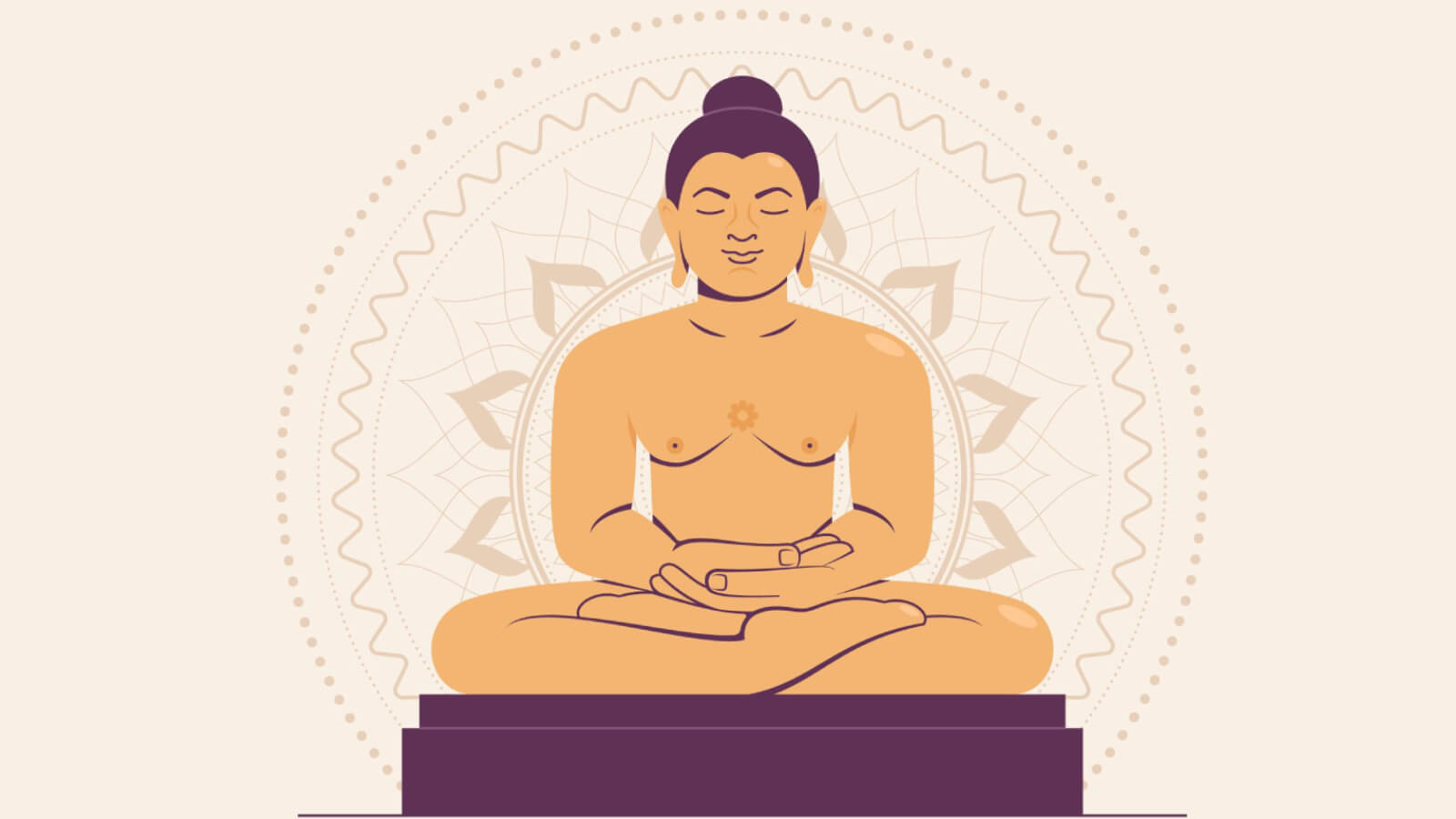
Jainism, one of the most ancient and profound spiritual traditions of India, offers a path not of belief, but of behaviour. It does not ask one to surrender to gods or doctrines, but to awaken within, to see clearly, and to live gently. Though numerically the smallest among India’s six major religions—comprising just 0.4% of the population—it has wielded a disproportionately large influence on the country’s cultural, intellectual, and ethical landscape.
Jainism is not loud. It does not seek conversions. It builds no empires. Its revolutions are inward. Its temples are not of stone alone, but of self-restraint. And its truth is carved not in proclamations, but in the silent renunciation of violence, desire, and illusion. This is why, for the Dwij, Jainism resonates deeply. It is a flame—quiet, unwavering, burning through ignorance with discipline and devotion.
Jains in Indian Society: Education, Wealth, and Caste Dynamics
According to the Pew Research Centre and India’s national census, Jain adults are among the most educated communities in India, with 34% having attained a bachelor’s degree or higher—compared to just 9% across the general population. This remarkable statistic reflects Jainism’s deep-rooted commitment to discipline, inquiry, and ethical living—traits that naturally support academic excellence and leadership.
Moreover, insights from the National Family and Health Survey reveal that Jains predominantly belong to India’s wealthiest socio-economic quintiles. This affluence is not merely a result of historical privilege, but also of a cultural ethos grounded in honesty, non-extravagance, and entrepreneurial spirit. Jains, unlike other major religious groups, mostly identify with the General Category caste, with only 20% identifying as Scheduled Castes, Scheduled Tribes, or OBCs—compared to 68% of the broader Indian population.
Thus, Jainism does not merely function as a religion—it shapes a way of life that impacts education, commerce, and moral influence, far beyond its demographic size.
The Soul, the Seeker, and the Path of Liberation
The term Jainism is derived from Jina—”the conqueror,” one who has overcome the passions and illusions that bind the soul to the cycle of birth and death. The root concept is jiva, the immortal soul, believed to be present in every living being—from the tiniest microbe to the mightiest human. The central objective of Jain life is to free this soul from samsara—the perpetual wheel of reincarnation—through spiritual discipline, ethical purity, and total non-violence.
The religion is traditionally traced back to Mahavira (c. 599–527 BCE), the 24th and final Tirthankara (ford-maker)—not a founder, but a revealer of eternal truths. Mahavira was born into royal privilege but renounced everything at the age of 30, embracing an ascetic life of silence, fasting, and meditation. After 12 years of rigorous spiritual practice, he attained kevala jnana (omniscience) and spent the rest of his life teaching.
By the time of his death, Mahavira had established a vast community of monks and nuns, said to number over 50,000. His teachings were never meant to start a new religion, but to revive and formalise an ancient wisdom tradition—a truth believed to have been known to 23 Tirthankaras before him.
Ahimsa: The Heartbeat of Jainism
At the very core of Jain philosophy lies the principle of Ahimsa—non-violence, not just in action, but in thought, speech, and intention. It is the single most defining and uncompromising tenet of Jain ethics. Every soul, whether human, animal, plant, or microorganism, is seen as sacred. Every act of harm is an act against the soul’s own liberation.
This is why Jains practise extreme forms of vegetarianism. They avoid not only meat and eggs but also root vegetables like onions, garlic, and potatoes—because harvesting them kills the entire plant and disturbs countless microorganisms in the soil. Water is filtered. Paths are swept to avoid crushing insects. Even speech is softened, for harsh words are seen as a form of violence.
Ahimsa is not a restriction. It is a liberation—from anger, from ego, from the illusion of separation.
This spiritual ideal influenced none other than Mahatma Gandhi, whose philosophy of Satyagraha was deeply shaped by the writings of Shrimad Rajchandra, a Jain philosopher and poet who mentored Gandhi in matters of soul and truth. In Gandhi’s hands, Ahimsa became not only a personal ethic but a national revolution.
The Five Vows: Anchors of Liberation
To walk the Jain path is to live by five central vows (mahavratas), especially for ascetics, and their gentler counterparts (anuvratas) for laypeople. These form the framework of Jain ethical conduct:
- Ahimsa (Non-violence): Total abstention from causing harm, whether physically, verbally, or mentally.
- Satya (Truthfulness): Speaking only what is true and beneficial.
- Asteya (Non-stealing): Taking only what is willingly given.
- Brahmacharya (Celibacy or Chastity): For monks, complete celibacy; for laypeople, faithfulness in marriage.
- Aparigraha (Non-possession): Letting go of attachments to objects, people, status, and even ideas.
Importantly, Jainism teaches that thoughts are as potent as actions. To think violently is to create karmic bondage. Liberation is not found by outward conduct alone—but by inward purity.
A true Dwij recognises this: rebirth does not happen in another life—it begins the moment one withdraws from harmful thoughts and steps into self-mastery.
No God, No Saviour—Only You
Jainism is a nontheistic tradition. It acknowledges the existence of celestial beings (devas), but they are neither omnipotent nor immortal. They cannot help one escape samsara. There is no creator God, no final judge, no divine hand to intervene in karmic justice.
Salvation (moksha) in Jainism is entirely self-earned. You must do the work. You must purify the mind. You must dissolve the ego. This stark spiritual autonomy is what makes Jainism both radical and empowering.
In a world eager for quick solutions, Jainism quietly insists: Do not look up. Look within.
Two Sects, One Goal: Digambara and Śvētāmbara
Over time, two major sects emerged:
- Digambara (“sky-clad”) monks wear no clothing, symbolising absolute renunciation. They believe women must be reborn as men to attain liberation.
- Śvētāmbara (“white-clad”) monks and nuns wear white garments. They accept that women too can achieve liberation and have preserved most of the canonical scriptures.
Despite their differences, both sects uphold the core Jain tenets: non-violence, renunciation, self-discipline, and soul-liberation.
Their practices diverge, but their destination is the same: the crossing beyond suffering into the ocean of peace.
Jain Scriptures: Oral Wisdom, Eternal Light
The teachings of Mahavira were not written down during his lifetime. Instead, they were memorised, recited, and passed orally for centuries. The Agamas—the primary Jain scriptures—are collections of these oral traditions. They contain teachings on ethics, cosmology, metaphysics, and spiritual discipline.
Among the Śvētāmbaras, the Agamas are considered sacred. The Digambaras, however, do not accept the current Agama canon, believing it to be a partial reconstruction. Instead, they regard texts like the Tattvārtha Sutra as authoritative—the only text accepted by both sects.
The Tattvārtha Sutra, dating between the 2nd and 5th centuries CE, lays out the seven fundamentals of Jain metaphysics, including soul (jiva), matter (ajiva), karma, and liberation. It is both a spiritual map and a philosophical mirror—revealing the nature of reality and the path beyond it.
Oral transmission remains central even today. Jain ascetics do not claim ownership over texts. Instead, they memorise, recite, and embody the teachings, ensuring the flame of knowledge continues unbroken.
Living the Dwij Way, the Jain Way
Jainism is not a religion for spectacle. It does not build empires or seek mass conversions. It invites the few who are ready to burn the ego and walk the razor’s edge of self-restraint.
For the Dwij, the Jain way is a mirror. Its fierce ethical code, its disciplined inner path, its uncompromising devotion to non-violence—all align with the Dwij philosophy of conscious rebirth. The Dwij too seeks to transcend karmic bondage, not through escape, but through stillness, service, and silent transformation.
To become a Tirthankara, in Jain terms, is to become a Dwij in Living Dwij: reborn as a bridge for others, crossing the stream of suffering into the shoreless ocean of peace.
Jainism and the Soul’s Revolution
In a world driven by conquest and consumption, Jainism whispers a different truth:
- Victory is in self-conquest.
- Freedom is in formlessness.
- Silence is the highest speech.
- Non-violence is the loudest protest.
It tells us: you are not here to dominate. You are here to dissolve. To untangle yourself from every knot of ego, desire, and illusion.
And perhaps, one day, when all your karma is shed, when all your wounds are stitched with compassion, when your thoughts no longer tremble with violence—you will rise.
Not as someone new, but as someone true.Living Dwij. Living Ahimsa. Reborn in Soul. Rooted in Truth.
A Path Beyond Birth, A Silence Beyond Death.