Republic Day: A Quiet Freedom
(Based on the live discourse of Param Dwij)
(परम द्विज के प्रवचन पर आधारित)
A Republic Day Letter by Param Dwij
When a Nation Remembers Itself
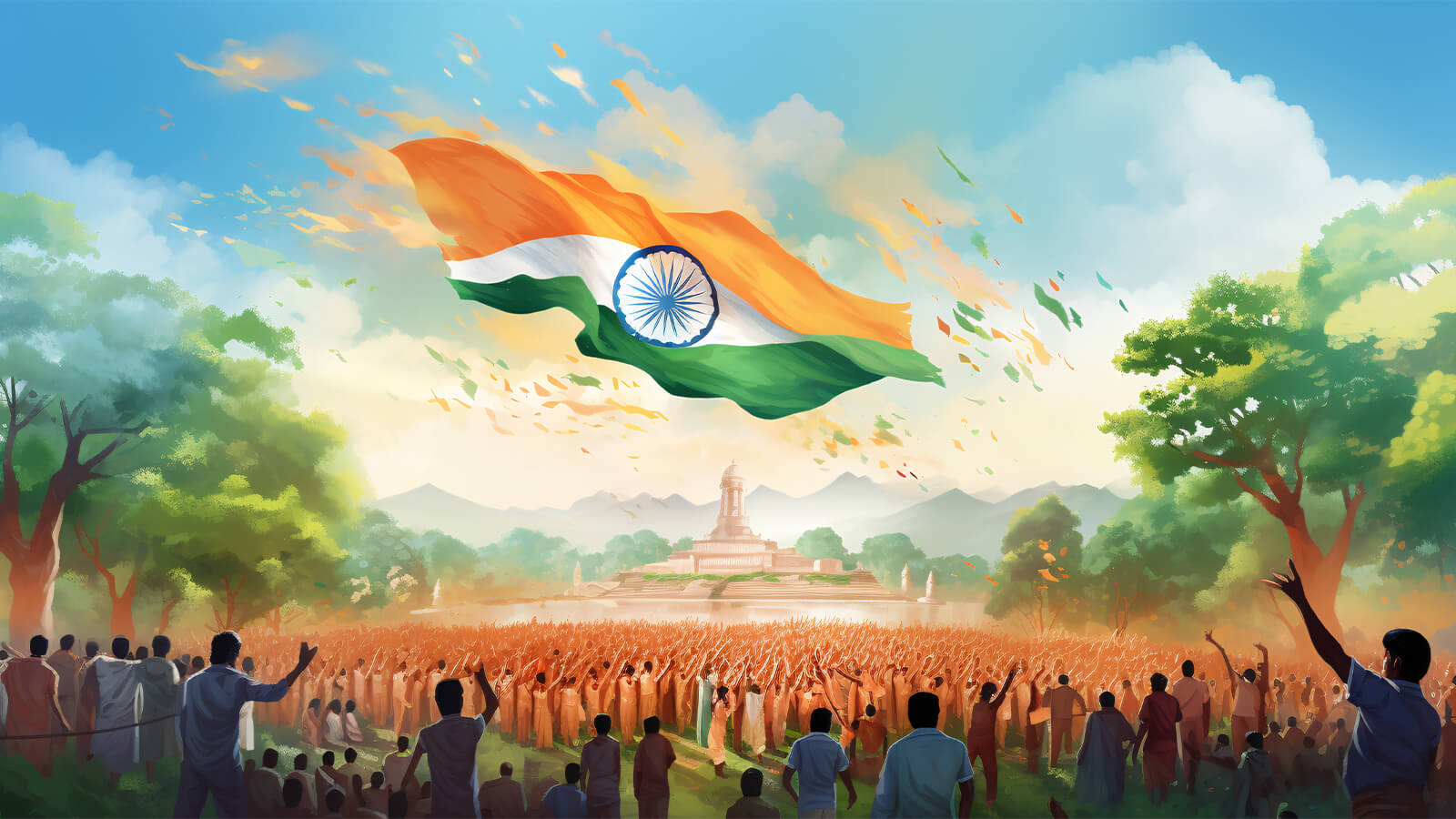
Republic Day arrives every year with a familiar rhythm. Flags rise. Speeches begin. The air fills with pride, patriotism, and celebration. The nation remembers itself publicly—its history, its Constitution, its struggle, its identity. And in that remembrance, something important is kept alive.
Yet I have also noticed that many people experience this day only on the surface. It becomes a ritual we observe rather than a truth we inhabit. We celebrate freedom as an idea, but we do not always examine what freedom demands from us inwardly. We honour the Constitution with words, yet forget that its spirit was never meant to remain inside books. It was meant to live inside human beings.
So I return, once more, to stillness.
Because for me, Republic Day is not merely a national event. It is a reminder. A reminder that identity is not the same as integrity. That slogans are not the same as values. That true freedom is not what we shout—it is what we live.
The Meaning of “Republic” Beyond Celebration
A republic is not simply a structure of government. It is an agreement. It is the idea that the nation belongs to its people, not to a ruler, not to a dynasty, not to a single voice. It is the decision to place power inside principles rather than personalities.
This decision is not small. It is not automatic. It must be renewed repeatedly—not just by changing leaders, but by nurturing the public conscience that protects a nation’s moral spine.
When I think of the word “Republic,” I do not think only of Parliament or policies. I think of responsibility. I think of the burden of choice. I think of a nation choosing to be governed by values, even when impulses pull it toward convenience.
In a republic, the people do not merely receive freedom. They hold it. They guard it. They prove themselves worthy of it. And that is where Republic Day becomes personal for me.
Freedom as an Inner State
We often speak about freedom as though it is external—freedom from colonisation, from oppression, from poverty, from injustice. All of these matter. They shape the reality of daily life. They determine whether a person can live with dignity. But I have also come to understand that a nation cannot remain free if its people remain imprisoned inwardly.
Imprisoned by fear.
Imprisoned by hatred.
Imprisoned by division.
Imprisoned by blind loyalty.
Imprisoned by the need to be right at all costs.
I have seen individuals who live in a free country yet do not feel free within themselves. Their minds are ruled by comparison and rage. Their choices are driven by insecurity. Their dignity is traded for approval.
And I have also seen something else: when enough individuals lose inner freedom, society begins to lose outer freedom too. Slowly, silently. Not always through violence, but through apathy. Through moral numbness. Through the gradual lowering of standards.
So on Republic Day, I not only salute the nation. I ask myself a deeper question. Am I free enough inside to live responsibly outside?
The Constitution as a Living Mirror
The Constitution is often treated as a document—something legal, something intellectual, something meant only for governance. But I see it as a mirror. It reflects not only what a nation is supposed to be, but what it risks becoming when principles are forgotten.
Justice. Liberty. Equality. Fraternity.
These are not words meant to decorate a preamble. They are values intended to shape behaviour—daily behaviour. Human behaviour. Social behaviour. These values do not survive because they are written. They survive because people choose them repeatedly, especially when it is difficult.
It is easy to speak of justice when we are not harmed. It is harder to practice justice when we are angry. It is easy to talk about equality when we are privileged. It is harder to practice equality when our ego wants superiority. It is easy to speak of liberty when it benefits us. It is harder to support liberty when it protects someone we disagree with.
Republic Day reminds me that values are tested most precisely when emotions rise.
Patriotism Without Inner Discipline
Patriotism, as I have come to understand it, is not noise. It is not aggression. It is not blindness.
True patriotism is the ability to love the country without hating its people. It is the ability to hold pride without losing humility. It is the ability to support the nation while still demanding truth from it.
A nation does not become strong because its citizens shout louder. It becomes strong because its citizens mature inwardly. Because they develop patience, responsibility, emotional intelligence, and ethical restraint.
If my patriotism makes me cruel, I have misunderstood it. If my patriotism makes me arrogant, I have misused it. If my patriotism makes me numb to suffering, I have betrayed it.
I cannot call something love if it destroys empathy. So I remind myself on this day: I do not need to prove my love for my country through conflict. I need to express it through conscience.
Living Dwij and the Idea of a Nation That Lives Consciously
Living Dwij is my organisation, but it is also my attempt to bring a particular kind of consciousness into daily life—without grand claims, without performance. Through Living Dwij, I have learned that spirituality is not separate from society. It is not an escape from citizenship. It is not an exit from responsibility.
A conscious person cannot ignore the world.
Republic Day, for me, is not only about remembrance. It is about participation. It is about asking whether I am contributing to the maturity of the nation or merely consuming its benefits.
A republic survives when citizens develop inner depth. When people stop living from impulse and begin living from principle. If Living Dwij has any purpose, it is to help people return to this kind of living—not as ideology, but as practice.
The Freedom I Owe My Country
I have asked myself many times what I truly owe my country, beyond symbolic pride. The answer is not complicated, but it is demanding.
I owe my country truthfulness, especially when lying is convenient. I owe my country respect for the law, even when breaking it seems minor. I owe my country basic civic sense, even when no one is watching. I owe my country a refusal to normalise corruption, cruelty, and indifference.
Most importantly, I owe my country a conscience that does not sleep. A nation cannot remain strong if its citizens become emotionally reactive and morally lazy. The decline of a republic begins when people become addicted to outrage and allergic to responsibility.
So on Republic Day, I remind myself: my daily actions are political, whether I admit it or not. Not because everything must become debate, but because everything contributes to culture.
How I speak.
How I treat differences.
How I handle power.
How I respond to injustice.
How I use my voice.
These things build the nation quietly, brick by brick.
The Republic Is Not “Them” — It Is Us
It is easy to think of the nation as something external—something the government controls, something leaders shape, something history carries forward. But the republic is not only an institution. It is a collective character.
Every time we justify dishonesty, we weaken it. Every time we normalise injustice, we weaken it. Every time we excuse hatred in the name of loyalty, we weaken it. And every time we choose integrity, we strengthen it.
This is why I do not treat Republic Day solely as a holiday. I treat it as a mirror, asking: what kind of citizen am I becoming? A republic is not maintained by celebration. Standards maintain it.
What I Carry Forward
I do not carry mere pride into this day. I carry responsibility. I have gratitude, yes—but not the kind that makes me blind. The kind that makes me careful.
I carry the understanding that freedom is not only inherited. It must be protected through maturity. I am aware that constitutional values are not preserved through memory alone. They are maintained through daily practice.
Through Living Dwij, I have learned that conscience must be lived, not admired. This is not discipline. This is alignment.
Forgetting and Returning
I know I will forget. I know distraction will return. I know there will be days when my attention narrows, and my emotions outweigh my principles. I do not dramatise this.
Returning is part of the practice. Each time I return to awareness, I return to responsibility. Each time I return to integrity, I return to citizenship. Each time I return to empathy, I return to the spirit that makes a republic worth protecting.
I trust sincerity over performance. I trust inner work over public declarations.
Entering the Day
I do not celebrate Republic Day with a rehearsed identity. I do not wear patriotism like armour. I enter this day with quiet respect and with an inward question. Am I becoming the kind of citizen this republic deserves?
I do not ask for perfection. I ask for presence. Presence in my choices. Presence in my ethics. Presence in the way I treat people who are different from me. The republic does not ask for noise. It asks for conscience.
A Closing Reflection
As I move through this day, I do so without shallow optimism and without concealed despair. I let clarity guide respect. I let awareness precede opinion. I let patience soften impulsiveness.
May I honour the nation not only with words, but with conduct. May I protect freedom not only through pride, but through responsibility? May I remember that the Constitution is not a book to quote, but a spirit to live. May I strengthen the republic not by demanding perfection from others, but by practising integrity within myself.
I stand still once more.
Now, I step forward.
— Param Dwij