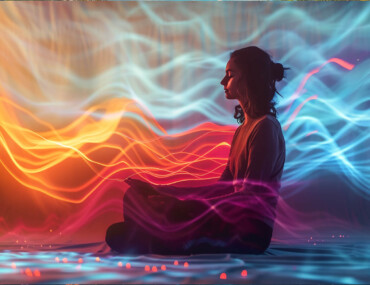
The Intelligence of Letting Go: A Living Dwij Exploration of Inner Freedom
(Based on the live discourse of Param Dwij)
(परम द्विज के प्रवचन पर आधारित)

There comes a moment in every inward journey when the seeker realises that growth is not only about acquiring more—more knowledge, more discipline, more awareness—but also about releasing what has quietly accumulated within. The human mind, conditioned to build, to collect, to strengthen its sense of identity, often overlooks a subtler movement of evolution: the movement of letting go. Within the Living Dwij philosophy, this movement is not seen as loss, nor as passive surrender, but as an intelligent, conscious act of returning to inner freedom. Letting go, in its deepest sense, is not weakness. It is clarity in motion.
From the earliest stages of life, we are taught to hold on. We hold on to achievements as proof of our worth, to relationships as anchors of our identity, to beliefs as frameworks of certainty, and to memories as evidence of who we have been. This tendency is not accidental—it is deeply rooted in the psychological need for continuity. The mind seeks stability by constructing a narrative of self, a story that feels coherent and secure. Yet over time, this very narrative begins to limit us. What once provided structure gradually becomes confinement.
Param Dwij often reflects on this paradox. He suggests that the same mind that seeks freedom also builds the very walls that restrict it. We accumulate experiences, identities, and expectations, believing they will strengthen us, yet they quietly begin to define us in ways that prevent genuine evolution. The problem is not in having experiences or roles, but in becoming attached to them as fixed truths.
Letting go begins when we start to question this attachment. This questioning is not intellectual alone—it is experiential. It arises in moments when we feel the weight of our own inner world, when a memory continues to shape our present long after the event has passed, when a belief restricts our ability to see new possibilities. When a relationship becomes defined by expectation rather than connection. These moments carry a subtle discomfort, a quiet signal that something within us is ready to be released.
Yet the act of letting go is rarely immediate. It confronts one of the deepest fears within the human psyche—the fear of emptiness. If we release what we have been holding, who are we without it? This question reveals the core resistance to letting go. Our attachments are not merely external; they are woven into our sense of identity. To let go of them feels like dissolving a part of ourselves. The mind interprets this as loss, as instability, even as danger.
The Living Dwij path approaches this fear with a different understanding. It suggests that what we are afraid of losing is not the self, but the illusion of a fixed self. Beneath the layers of identity, there exists a deeper presence—one that is not defined by past experiences or external roles. Letting go does not erase us; it reveals us.
This revelation, however, unfolds gradually. The intelligence of letting go lies in its subtlety. It is not about forcefully abandoning aspects of life, nor about rejecting responsibilities. It is about seeing clearly what no longer serves our growth and allowing it to dissolve naturally. This requires awareness, patience, and a certain inner honesty that cannot be rushed.
Consider the nature of emotional attachment. Many individuals carry unresolved emotions for years—resentment, guilt, regret, longing. These emotions persist not because they are inherently permanent, but because they are continuously reinforced through thought. The mind revisits past events, reinterprets them, and sustains their emotional charge. Letting go, in this context, does not mean forgetting the past. It means releasing the ongoing identification with it.
When we observe an emotion without feeding it, its intensity gradually diminishes. Over time, it loses its grip on our present experience. This is not suppression—it is liberation through awareness. Similarly, in the realm of beliefs, letting go involves recognising the limitations of our own perspectives. Every belief we hold has been shaped by experience, culture, and conditioning. While beliefs can provide guidance, they can also create rigidity. When we become too attached to a particular way of seeing the world, we close ourselves off to new understanding.
The Living Dwij philosophy encourages a fluid relationship with belief. It invites us to hold our perspectives lightly, to remain open to change, and to recognise that truth is often more expansive than any single interpretation. Letting go of rigid beliefs does not lead to confusion; it creates space for deeper insight. Another dimension of letting go involves relationships. Human connections are among the most profound aspects of life, yet they are also the areas where attachment is most intense. We often hold on to people not only out of love, but out of fear—the fear of loneliness, of change, of losing a part of ourselves.
Param Dwij speaks of a distinction between connection and possession. True connection arises from presence and mutual respect, while possession arises from attachment and expectation. When we hold on to others as extensions of our identity, relationships become strained. We expect them to behave in ways that reinforce our sense of self. Letting go in relationships does not mean withdrawing love. It means releasing control. It means allowing others to exist as they are, without imposing our narratives upon them. This shift transforms relationships from sources of tension into spaces of genuine connection.
The intelligence of letting go also extends to ambition and personal growth. In a world that celebrates constant striving, the idea of letting go may appear counterintuitive. Yet much of the stress associated with ambition arises not from the pursuit itself, but from the attachment to outcomes. We set goals, which is natural. But then we begin to attach our identity to achieving them. Success becomes validation; failure becomes self-doubt. This attachment creates pressure, anxiety, and a constant sense of urgency.
The Living Dwij path does not discourage ambition—it refines it. It encourages action rooted in clarity rather than attachment. When we act with full commitment while letting go of the need for a specific outcome, our engagement becomes more present and less burdened. This does not reduce effectiveness; it enhances it. A mind that is not consumed by anxiety about results is more focused, more creative, and more resilient. Letting go, therefore, is not a retreat from life. It is a deeper participation in it.
At a more subtle level, letting go reveals the transient nature of all experiences. Thoughts arise and pass. Emotions come and go. Situations change. Even identities evolve. When we observe this impermanence directly, attachment begins to loosen naturally. We realise that holding on tightly to what is constantly changing creates unnecessary suffering. This realisation does not lead to detachment in the sense of indifference. Instead, it leads to a more profound engagement with life. When we are not clinging to outcomes or identities, we become more present. We experience moments more fully, relationships more deeply, and actions more consciously.
In this presence, life feels less like something to control and more like something to participate in. The Living Dwij philosophy ultimately points toward a deeper dimension of letting go—the letting go of the constant need to define oneself. The mind seeks to create a stable identity: I am this kind of person, I believe in this, I follow this path. While such definitions provide orientation, they can also become limitations.
When we loosen our attachment to fixed identities, we discover a different way of being—one that is fluid, responsive, and open. We are no longer confined by rigid self-concepts. We can grow, adapt, and evolve without resistance. This fluidity is not instability; it is freedom. Param Dwij often describes this state as a form of inner spaciousness. A space where thoughts arise without dominating, emotions flow without overwhelming, and experiences unfold without creating rigid attachments. In this space, there is clarity, calm, and a quiet sense of completeness.
Reaching this state does not require extraordinary effort. It requires consistent awareness. Each moment presents an opportunity to observe what we are holding on to. Each moment offers a choice—to cling or to release. Over time, these small choices accumulate. The mind becomes lighter. The inner world becomes less crowded. What remains is not emptiness, but openness. And within that openness, something profound emerges. A sense of freedom that is not dependent on circumstances. A stability that does not rely on certainty. A peace that does not require control.
This is the intelligence of letting go. It is not an act of giving up, but an act of seeing clearly. It is not about losing what matters, but about releasing what obscures it. It is not about withdrawing from life, but about engaging with it without unnecessary burden. In a world that constantly encourages accumulation—of success, of identity, of experience—the practice of letting go becomes a quiet revolution. It shifts the focus from external achievement to internal clarity.
And in that clarity, the Living Dwij path reveals its deepest insight: that freedom is not something we acquire, but something we uncover when we release all that we are not. When we learn to let go intelligently, consciously, and compassionately, we do not become less. We become lighter, clearer, and more aligned with the essence of who we have always been. And in that alignment, life ceases to feel like something we must control—and begins to feel like something we can finally understand.