Sikhism: The Eternal Flame of Oneness, Courage, and Compassion
(Based on the live discourse of Param Dwij)
(परम द्विज के प्रवचन पर आधारित)
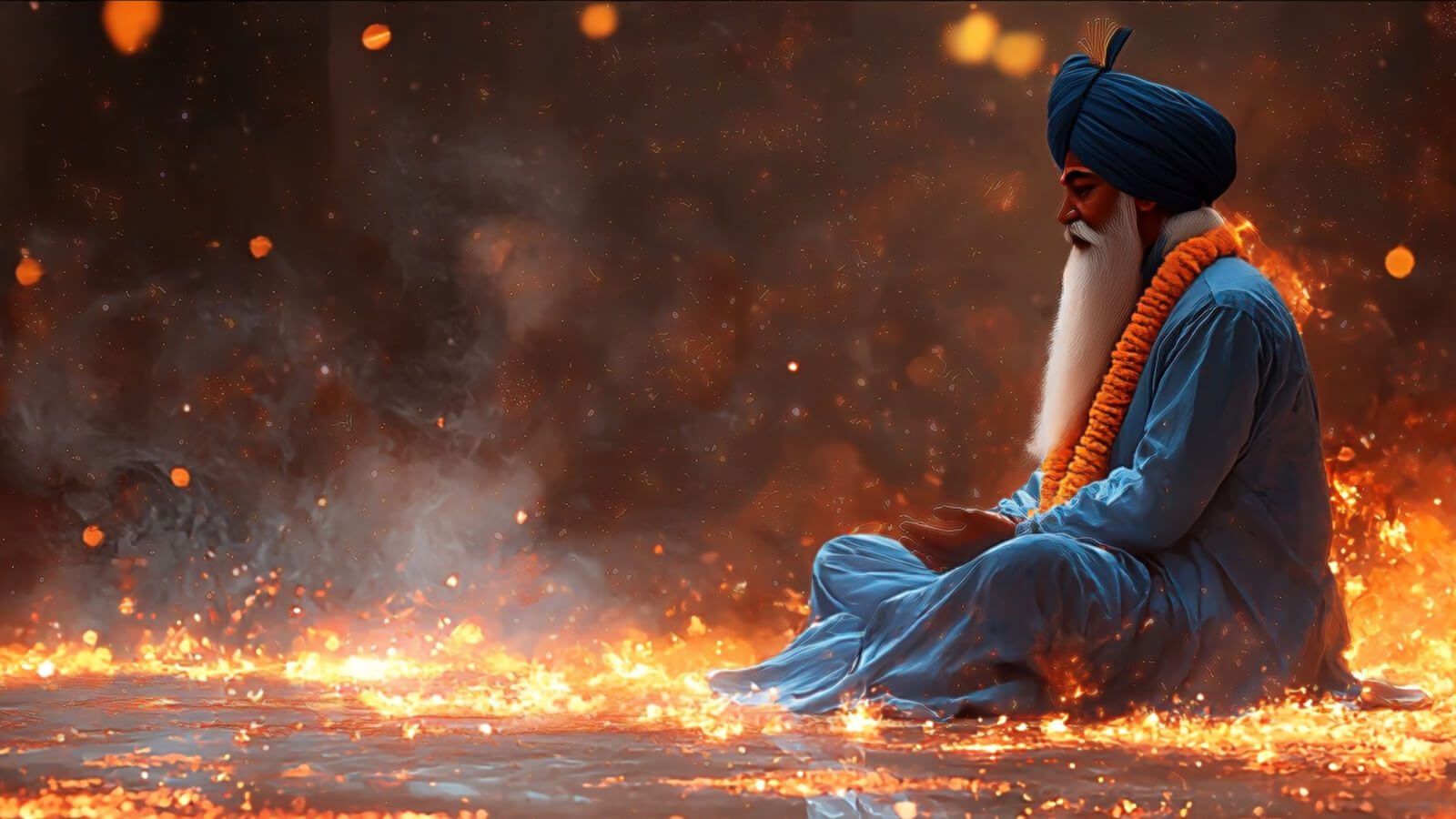
Sikhism is a vibrant, compassionate, and deeply courageous spiritual tradition born on the soil of the Indian subcontinent over 500 years ago. With over 26 million adherents today, it is the fifth-largest religion in the world. But more than a religion, Sikhism is a living path—a way of being that blends devotion with justice, inner stillness with outer service, and remembrance with revolutionary compassion. It is not a path of escape, but of fearless engagement.
At its heart is the message of Ik Onkar—the truth that “There is but One Universal Creator.” That this presence is within and without. That God is not confined to temples, texts, or rituals—but lives in every breath, every blade of grass, and every cry for justice.
Guru Nanak Dev Ji, born in 1469 in Talwandi (now Nankana Sahib in Pakistan), was the radiant seed from which Sikhism would bloom. He was no prophet calling people to a sect—he was a mystic who shattered sectarianism altogether. His famous declaration—“There is no Hindu, there is no Muslim”—was not a rejection of faith, but a transcending of labels. It was a call to awaken to the Divine Light within.
The Life That Became a Flame
Born into a Hindu Khatri household, Nanak was contemplative from the start. While other boys played, he questioned. While others memorised rituals, he sang. His sister, Nanaki, recognised his brilliance early on. As he grew, he studied both Hindu and Islamic texts, worked as a storekeeper for a Muslim nobleman, and developed a deep affection for the poor, the marginalised, and the divine.
Then came the moment that transformed everything. Around the age of thirty, Nanak disappeared into the river near Sultanpur. For three days, he was gone—believed to have drowned. When he returned, his eyes sparkled with silence. His first words were:
“There is no Hindu. There is no Muslim. Only the Creator’s Light.”
He had seen beyond duality. He had experienced the Nameless One—not as dogma, but as direct truth. And from that moment, he renounced worldly ties, walked barefoot across lands, and sang of the Naam—the sacred Name of the Divine that beats within all.
A Faith Carried by Song and Sword
Guru Nanak was not a solitary mystic. He travelled with Mardana, a Muslim companion and rabab player. Together, they composed divine poetry—Gurbani—and sang in the bazaars, fields, mosques, and temples. Their kirtan was not entertainment—it was transmission. Words soaked in grace, melodies braided with truth.
Over time, the Sikh tradition was carried forward by ten Gurus—a lineage of enlightened masters who shaped Sikhism into a comprehensive spiritual, ethical, and social revolution. The tenth Guru, Guru Gobind Singh, would formalise the Sikh identity, create the Khalsa, and finally bestow the status of Eternal Guru upon the Guru Granth Sahib—the sacred scripture that now serves as the guiding light for Sikhs across time.
Ik Onkar: One Light, Countless Forms
Sikhism is monotheistic, but not in the hierarchical sense. It teaches that the same Divine presence flows through all beings—regardless of caste, religion, gender, or birth. The name used—Waheguru—means “Wondrous Teacher,” not in the sense of a ruler in the sky, but as the still, guiding presence within.
This God is Nirgun and Sargun—without qualities, and with all qualities. Both transcendent and immanent. Formless, yet fully present in form. Thus, Sikhism urges one not to worship idols or look outside, but to look within, chant the Name (Naam Japna), and live with integrity (Kirat Karni), compassion (Seva), and detachment from ego (Haumai).
Revolution in Name and Form
Sikhism dismantled not just religious exclusivity, but social oppression. Under Guru Gobind Singh’s leadership, the caste system was obliterated through symbolic re-naming. All men were given the surname Singh (lion), and all women were given the surname Kaur (princess)—ending centuries of caste-encoded surnames and societal stratification.
Furthermore, Guru Gobind Singh instituted the Five K’s as markers of Sikh discipline and sacred identity:
- Kesh – Unshorn hair: a symbol of acceptance of divine will.
- Kangha – A small wooden comb: symbolising cleanliness and order.
- Kara – A steel bracelet: a reminder of restraint and commitment to truth.
- Kachera – Modest cotton breeches: signifying discipline and dignity.
- Kirpan – A ceremonial sword: representing courage and the duty to protect.
These were not mere cultural artefacts. They were spiritual tools—reminders of a life lived in courage, humility, and balance. In Living Dwij terms, these are the external anchors that sustain the inner fire of rebirth.
The Khalsa: Baptism by Courage
In 1699, Guru Gobind Singh tested his followers’ devotion by asking for a head. Five men stepped forward—known as the Panj Pyare (Five Beloved Ones)—from different castes, ready to die for truth. Instead, they were initiated into the Khalsa, a collective of warriors and saints, defenders of dharma and dignity.
The Khalsa was not a tribe of violence—it was an order of fearlessness. In their swords sang the hymns of justice. In their stillness bloomed divine remembrance.
This blend of Simran (meditation) and Seva (service) became the core of Sikh practice. It was not enough to remember God in silence—one had to live God in action. This is the essence of Sant-Sipahi—one who is both still and brave.
The Living Guru: Shabad as Shakti
When the tenth Guru declared that there would be no more human Gurus after him, he handed over the spiritual torch to the Guru Granth Sahib—a sacred scripture of poetry, music, and mystic truths, containing verses not only by Sikh Gurus, but by Hindu Bhaktas and Muslim Sufis as well.
In this, Sikhism became radically inclusive. It was not about who wrote the truth—it was about what the truth was. In the Dwij sense, this is Shabda Shakti—the Word as Energy. Vibration as Liberation.
The Gurbani, when sung in devotion, carries the seeker beyond intellect into direct resonance with the Divine. This is not passive listening—it is embodied remembrance.
Sikhism and the Dwij Ideal
Sikhism aligns powerfully with the Living Dwij philosophy of conscious rebirth. Just as the Dwij is “twice-born”—not through ceremony, but through awareness—the Sikh is not merely born into a family, but initiated into remembrance.
- The Naam is the breath of the Dwij, the still point within the cyclone.
- The Khalsa discipline echoes the Dwij disciplines—outward simplicity, inward sovereignty.
- The Guru’s Word, like Param Dwij’s voice, is not instruction—it is ignition.
- The path of Seva—like Dwij service—is not charity, but transformation.
Sikhism teaches that this life is not punishment, but opportunity. That every moment is a chance to awaken. And that liberation (mukti) is not in some afterlife, but in the present, when one dissolves the ego, remembers Naam, and becomes a vessel of grace.
Closing Reflection
Guru Nanak did not come to create a religion. He came to ignite a revolution of the soul. He taught that God does not reside in rituals, robes, or robes—but in the heart of the fearless, the just, the still.
In the world of Living Dwij, the Sikh path reminds us that to be reborn is not to escape the world—but to see it anew. With eyes of devotion. With hands of service. With a spine that does not bow to injustice.
“Nanak Naam Chardi Kala. Tere Bhaane Sarbat Da Bhala.”
Through remembrance of Naam, may we rise in high spirits. And may the will of the Divine bring blessings to all of creation.