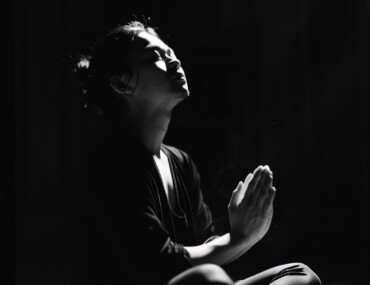
Steadfastness in the Jain Way: Karma, Devotion, and Knowledge
(Based on the live discourse of Param Dwij)
(परम द्विज के प्रवचन पर आधारित)

I. Steadfastness in Action
Karma as Matter, Bondage, and Self-Responsibility
In Jain philosophy, karma is not simply moral energy but an actual form of subtle matter (Pudgala) that clings to the soul. This is a strikingly unique position among Indian traditions. The soul (jiva) is inherently pure, omniscient, and luminous, but becomes entangled with karmic matter, which is drawn in through two forces:
- Yoga – the activities of mind, speech, and body.
- Kasaya – passions such as anger, pride, deceit, and greed.
Together, these create vibrational “currents” that attract karma, much like iron filings are pulled to a magnet. Once bound, karmic matter forms a karmic body around the soul, conditioning its births, experiences, and perceptions.
Unlike religions that allow for divine intercession, Jainism states plainly: no god, no Siddha, no Tirthankara can absolve your karma.
You alone bear the consequences of your deeds.
Two Causal Agencies
Jain thinkers such as Acharya Kundakunda refined this causality into two categories:
- Nimitta-karana (Dravya-karma): The remote or external cause—the karmic matter itself.
- Upadana-karana (Bhava-karma): The substantial or internal cause—the soul’s passions and vibrations.
Kundakunda taught that soul and karmic matter stand in mutual causation, but the soul’s inner states are decisive. When passions cease, karmic influx stops.
The Eight Types of Karma in Detail
Each karma is like a distinct “dust” cloud obscuring the soul’s qualities:
- Jnanavaraniya (Knowledge-Obscuring)
Blocks the soul’s inherent omniscience, dulls the intellect and senses. - Darsanavaraniya (Perception-Obscuring)
Clouds correct intuition and sensory clarity. - Vedaniya (Feeling-Producing)
Determines whether experiences are perceived as pleasant or unpleasant. - Mohaniya (Deluding)
The most potent karma—like intoxicating wine—distorting belief and conduct. When strong, it energises all other karmas; when weakened, others lose grip. - Ayu (Life-Span Determining)
Fixes the being’s lifespan in its next rebirth—human, plant, animal, or celestial. - Nama (Physique-Determining)
Shapes body type, form, spiritual capacity, and destiny of rebirth. - Gotra (Status-Determining)
Establishes high or low status within species—social and environmental conditions. - Antaraya (Obstructive)
Blocks the soul’s energy, preventing generosity, effort, and progress.
Ghatiya and Aghatiya Karmas
Jainism divides these into:
- Ghatiya Karmas – harm the soul’s essential qualities (knowledge, perception, bliss, energy):
Jnanavarana, Darsanavarana, Mohaniya, Antaraya. - Aghatiya Karmas – affect only external conditions (body, status, lifespan, feeling):
Ayu, Nama, Gotra, Vedaniya.
Destroying Ghatiya karmas leads to Kevalajnana (perfect knowledge).
Destroying Aghatiya karmas leads to moksha (liberation).
Metaphor of the Lake
Jain scriptures compare karmic influx to water streaming into a lake. Passions are the channels. Close the channels—anger, greed, deceit—and the lake clarifies. A Dwij lives exactly this way: a daily “closing of channels,” so no new sediment clouds the soul.
II. Steadfastness in Devotion
Bhakti Without Dependency, Prayer as Reflection
Jainism is a path of self-effort. This raises the question: if no god intervenes, what role does prayer or devotion (bhakti) play?
The answer lies in the Jain concept of Asarana-Bhavana—the contemplation that no one can rescue me; I must walk the path myself. Prayer does not change destiny. Karma does. Yet, Jainism does not discard prayer. It redefines it.
What Prayer Is—and Is Not
- A Siddha cannot be pleased or displeased. Liberated souls are pure knowledge and bliss. They do not grant boons.
- Prayer cannot override karma. Outcomes still follow causes.
- Prayer is self-mirroring. It is an aspirational act, a way to align yourself with the virtues of the liberated.
Thus, in Jainism, bhakti is not petition, but rather admiration. You do not “ask” Arihantas for favours; you “bow” to their qualities, yearning to cultivate them yourself.
The Navakara Mantra and the Pancha-Paramesthi
The most revered prayer, the Navakara Mantra, does not mention names or requests. It simply bows to five classes of beings—the Pancha-Paramesthi:
Namo Arihantanam — I bow to Arihantas (conquerors of passions).
Namo Siddhanam — I bow to Siddhas (fully liberated souls).
Namo Ayariyanam — I bow to Acharyas (spiritual heads).
Namo Uvajjhayanam — I bow to Upadhyayas (teachers).
Namo Loe Savva-Sahunam — I bow to all Sadhus (monks and nuns).
Each represents a rung on the ladder of liberation. Reciting this mantra daily is a practice of alignment, not appeasement.
Prayer as Steadfast Practice
Through prayer, Jains:
- Express gratitude for those who have crossed over.
- Reaffirm their commitment to ahimsa, compassion, and discipline.
- Aspire to embody the same virtues.
In the Living Dwij approach, this is referred to as “bhakti as calibration.” Each bow is an inner course correction. Each recitation is a polishing of the soul’s mirror.
III. Steadfastness in Knowledge
Jnana as Multi-Layered Awareness
Jain epistemology is among the most detailed of any Indian system. It divides knowledge into mediate (paroksha) and immediate (aparoksha) forms, then further into five “right” knowledges and three “wrong” ones.
Two Mediate Knowledges
- Mati Jnana (Sensory-Cognitive Knowledge)
Everyday cognition from senses and mind: perception (upalabdhi), memory (bhavana), recognition (pratyabhi), inference (anumana), reasoning (tarka). - Shruta Jnana (Scriptural Knowledge)
Knowledge by signs, symbols, or words. It is the bridge between raw perception and conceptual understanding. Includes association (labhdi), attention (bhavana), understanding (upayoga), and perspective-taking (naya).
Three Immediate Knowledges
a. Avadhi Jnana (Clairvoyance)
Direct perception of distant objects or times—like seeing beyond walls of space.
b. Manahparyaya Jnana (Telepathy)
Direct comprehension of another’s thoughts.
c. Kevala Jnana (Omniscience)
Absolute knowledge transcending time and space; total self-realisation; the state of a Siddha.
Wrong Knowledges to Transcend
- Anadhyavasaya: Wrong knowledge due to indifference.
- Viparyaya: Mistaken knowledge.
- Samshaya: Doubt.
At any moment, one of these eight (five correct and three incorrect) knowledge states is active. The spiritual journey is to replace the latter with the former until only omniscience remains.
Pramana and Naya: Two Modes of Knowing
- Pramana: Knowing a thing as it truly is—complete knowledge.
- Naya: Knowing a thing from a limited standpoint—partial knowledge.
This is the principle of Anekantavada—manifold viewpoints. No single view is final. Truth is a jewel with many facets. To impose one perspective is intellectual violence; to recognise multiple perspectives is intellectual non-violence.
In the Living Dwij frame, this is “knowing without harming”—a mental extension of ahimsa.
IV. Living the Dwij Way Through Jain Wisdom
When we weave these three pillars together, a clear path emerges:
- Karma (Action): Own every action. Stop the new influx. Burn old bonds.
- Bhakti (Devotion): Bow not to ask but to become. Reflect virtues, don’t project requests.
- Jnana (Knowledge): See with clarity and humility. Gather partial truths without clinging, move toward total insight.
Jainism demands no belief, only transformation. Its method is rigorous but luminous. Its end is not worship but awakening.
For the Dwij, Jainism is not a separate faith but a mirror—a reminder that conscious rebirth begins with self-mastery, blossoms through compassion, and culminates in omniscience.
Living Dwij. Living Ahimsa. Living Omniscience.
Steadfast in Action. Rooted in Devotion. Rising in Knowledge.