Fire, Dignity, and Devotion — A Month of Inner Maturity
(Based on the live discourse of Param Dwij)
(परम द्विज के प्रवचन पर आधारित)
Opening Reflection — When the Season Changes, So Can We
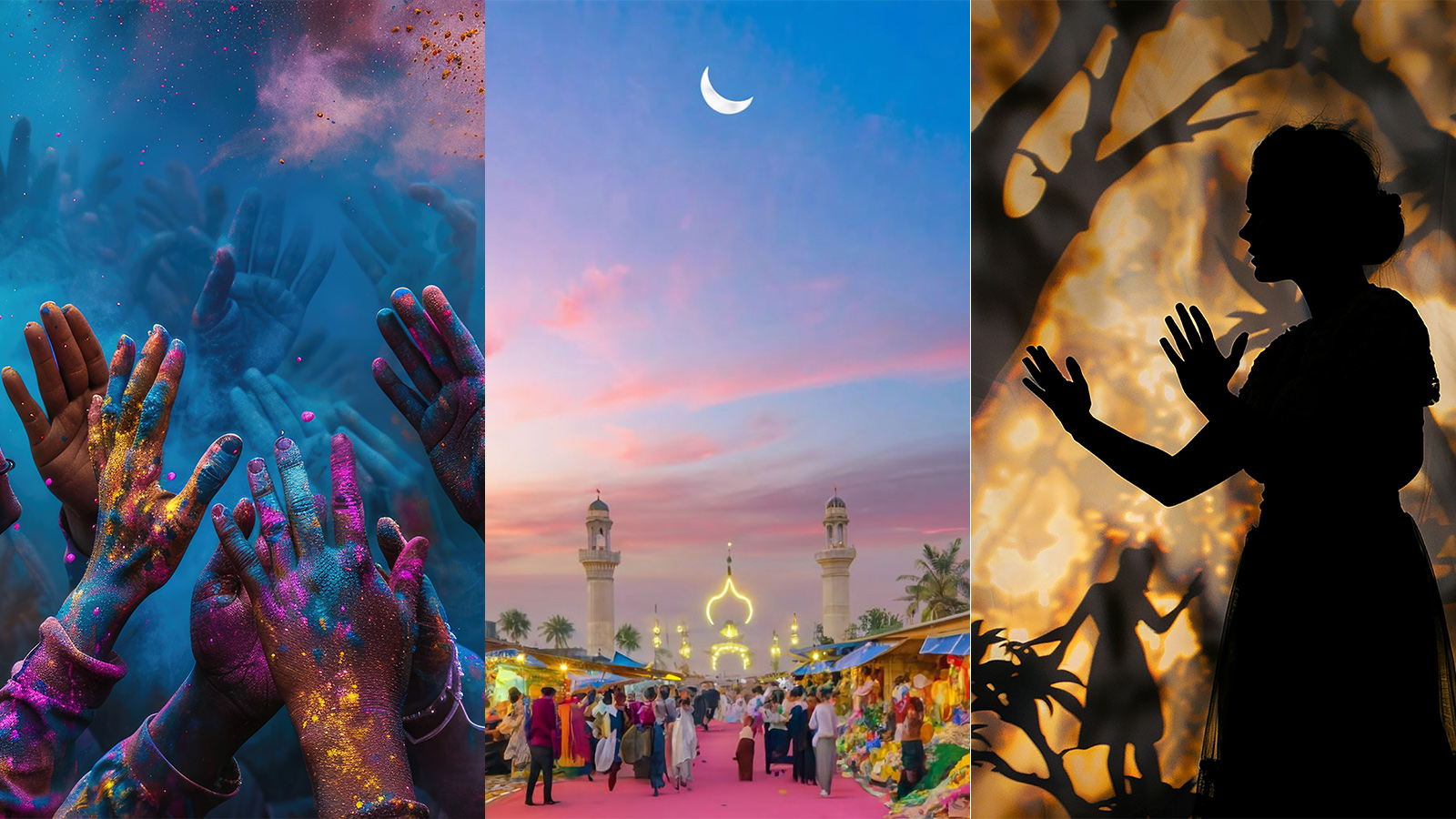
March is often described as the bridge between endings and beginnings. Winter loosens its hold, and spring does not rush in; it unfolds gradually. There is something symbolic in this transition. Growth is rarely abrupt. It is subtle, layered, and often invisible at first. In the same way, March carries within it three distinct observances — Holi, International Women’s Day, and Eid — that gently guide us through stages of inner refinement.
These occasions are not merely cultural markers. They are psychological checkpoints. They ask us to examine the way we live, the way we relate, and the way we receive. If we move through March mechanically, it will pass as a festive blur. If we move through it consciously, it becomes a month of maturation.
This is not a month that demands noise. It invites awareness.
Holi — The Necessary Fire Before Renewal
Holi is widely associated with vibrancy, laughter, and the eruption of colour. Streets come alive, distinctions blur, and playfulness becomes permission. Yet beneath this celebration lies a quieter, deeper beginning — fire. The ritual of Holika Dahan precedes the colours. This order is not accidental; it is instructional.
Fire symbolises the destruction of what has become excessive or harmful. It is not about punishment; it is about purification. In our lives, there are emotional residues we carry unconsciously — resentments that subtly influence our reactions, comparisons that erode our confidence, pride that isolates us from connection. These patterns are rarely dramatic, but they are persistent.
Holi invites us to take a moment of reflection before we dive into the vibrant celebrations of this festive occasion. It prompts us to ask a fundamental question: What is it that we need to release from our lives? This act of release isn’t about denial or pushing our issues aside; rather, it involves a deep recognition of what holds us back, coupled with a genuine willingness to move forward.
The bonfire that is central to Holi serves as a powerful symbol of this process. Its flickering flames embody the act of letting go. Still, its true significance is realised only when we consciously choose to let go of one limiting belief or narrative that restricts our growth. This could be the pervasive notion that we must continuously prove our worth to others, the heavy burden of clinging to past grievances that weigh on our spirits, or perhaps the silent competition that taints our relationships with jealousy and resentment.
Only after the ritual of burning these burdens can the celebration of colour truly commence. The vibrant hues of Holi go beyond mere joy and excitement; they represent a profound message of equality. When we throw colours at one another, the distinctions that often define us—such as status, wealth, and social identity—temporarily fade away. In those moments of shared laughter and splashes of colour, we are reminded that beneath the various labels we wear, we all share a fundamental humanity.
Holi teaches us an important lesson: celebration without a foundation of humility risks transforming into excess. However, when our celebrations are rooted in the act of release, they evolve into a genuine sense of freedom. As the hardness of our egos diminishes, the joy we experience becomes deeply authentic. To engage with Holi in a conscious manner means allowing the cleansing fire to purify our hearts and minds before we embrace the joyous colours that will adorn us. It’s a beautiful reminder that true celebration stems from letting go and recognising our interconnectedness.
International Women’s Day — From Appreciation to Accountability
International Women’s Day arrives with tributes and expressions of gratitude. While recognition is important, it must not remain symbolic. To honour women meaningfully is to examine the patterns that continue to limit equity and voice.
Inequality rarely survives through obvious injustice alone. It persists quietly — in interruptions during conversations, in assumptions about roles, in expectations of emotional labour that go unnoticed. These habits become normalised over time. Women’s Day challenges us to make the invisible visible.
Respect is not merely a statement we declare; it is an ongoing practice that requires our active engagement. When we take the time to reflect honestly on our interactions and behaviours, we may uncover subtle imbalances that exist within ourselves. These imbalances can manifest in various ways: perhaps we listen less attentively in conversations, we may unconsciously share responsibilities unevenly, or we might dismiss differing perspectives without realising it. It is essential to understand that the journey toward equality begins not with lofty proclamations but with a commitment to consistently correct these behaviours and attitudes in our everyday lives.
Moreover, beyond the societal structures that often shape our perceptions, there exists a more profound dimension to the meaning of respect, particularly as we observe this day dedicated to women. The feminine aspect, as understood in the Living Dwij perspective, transcends the boundaries of gender. It embodies qualities such as intuition, empathy, resilience, and creative intelligence. When society fails to value women appropriately, it inadvertently diminishes these invaluable qualities as a whole. For instance, strength devoid of empathy can often come across as harshness, while logic without the grounding of intuition may lead to rigidity. Similarly, efficiency that overlooks the importance of care can result in a dispassionate approach to both work and relationships.
International Women’s Day serves as a poignant reminder of our collective responsibility to restore balance in our communities. It urges us to cultivate respect not just as an emotion or sentiment, but as a foundational framework that shapes how we lead, engage in active listening, and extend our support to others. This call for action emphasises that true empowerment does not rely on grand displays or spectacles; rather, it is built on sincerity and a genuine commitment to fostering an environment where all voices are genuinely heard and valued. It is through these daily practices that we can work towards a more equitable society for everyone.
Eid — The Renewal That Follows Restraint
Eid marks the completion of Ramadan — a month defined by fasting, reflection, and spiritual discipline. In a world driven by instant gratification, the act of fasting appears countercultural. Yet within restraint lies profound clarity.
Fasting is not deprivation; it is awareness sharpened. When we consciously abstain from food and impulse, even temporarily, we rediscover gratitude. Hunger makes nourishment meaningful. Thirst makes water precious. Through voluntary limitation, entitlement softens.
Ramadan serves as a profound teacher of patience, inviting us to reflect on the nature of desire and its immediate fulfilment. Through fasting, we learn that we do not have to satisfy our cravings instantaneously; instead, we can observe our impulses thoughtfully rather than yielding to them without question. This spiritual discipline transcends the mere abstention from food and drink; it permeates our speech, our actions, and the intentions behind them. By consciously regulating these aspects of our lives, we cultivate a deeper awareness of our internal landscape and our interactions with others.
As Ramadan draws to a close, Eid marks the celebration of this inward journey and the personal growth it fosters. However, Eid is not merely a time for indulgence; it is a heartfelt celebration of renewed gratitude and community. The spirit of giving during this festive period plays a vital role in ensuring that joy is not confined to individual experiences but is instead shared among family, friends, and those in need. This act of generosity transforms personal celebrations into an opportunity for communal well-being, reinforcing the bonds that tie us together.
The sighting of the crescent moon signals the arrival of Eid, appearing gracefully in the sky as a symbol of hope and new beginnings. This crescent does not overshadow or dominate the horizon; instead, it humbly announces the end of Ramadan and the start of Eid with a gentle reminder of faith’s essence. Just as the moon quietly illuminates the night, faith flourishes in humility, often thriving without the need for loud proclamations or public displays. It finds strength in quiet trust and unwavering belief.
Moreover, Eid serves as a poignant reminder that devotion devoid of compassion is fundamentally incomplete. It teaches us that an abundance of blessings, if not met with gratitude, remains hollow. This celebration encourages us to reflect on the significance of compassion in our acts of faith and the importance of acknowledging the blessings we receive with a grateful heart. In doing so, we find a more profound meaning in our celebrations and a stronger connection to the wider world around us.
The Sequential Wisdom of March
When we observe the celebrations of Holi, International Women’s Day, and Eid in succession, we can discern a meaningful progression that mirrors our personal growth and transformation throughout the month of March.
First, Holi invites us to release what burdens us. The vibrant festival encourages us to let go of past grievances, negative emotions, and any weight that holds us back. Through the act of playfully throwing colored powders at one another, we engage in a powerful ritual of cleansing that allows us to step into a more liberated state of being.
Next, International Women’s Day presents an opportunity to correct what limits others. This day is dedicated to advocating for gender equality, celebrating women’s achievements, and actively challenging the barriers that prevent individuals, particularly women, from realising their full potential. It compels us to reflect on our responsibilities to uplift and empower those around us, fostering an environment of respect and support.
Finally, Eid brings forth the theme of renewal through gratitude and generosity. As we come together with family and friends, we share meals, exchange gifts, and express appreciation for the blessings in our lives. This celebration embodies the spirit of giving, encouraging us to practice kindness and gratitude not only on this special occasion but as a continuous part of our lives.
The act of release during Holi clears mental space, enabling us to reconnect with our true selves. The respect we foster on International Women’s Day plays a vital role in restoring dignity to those who have been marginalised. When we approach Eid with a heart full of gratitude, we deepen our awareness of the interconnectedness of all people and the importance of compassion.
Thus, March transforms into a map of inner evolution. It serves as a reminder that true maturity encompasses more than just achievements; it requires an alignment between our beliefs and actions, between celebration and humility, and between devotion and compassion. In navigating this month, we cultivate a richer understanding of ourselves and the world around us, ultimately paving the way for personal and collective growth.
Living March with Intention
This month, let’s focus on conscious engagement, a process that doesn’t demand complex rituals but rather calls for honest and thoughtful reflection.
As we approach Holi, a festival symbolising the victory of good over evil and the arrival of spring, take a moment to identify one emotional pattern in your life that you feel ready to let go of. Consider aspects such as recurring negative thoughts, unhealthy habits, or any emotions that no longer serve you. Write this pattern down on paper; this act of acknowledgement is significant in itself. Once you’ve done this, create a symbolic gesture of release — perhaps by tearing the paper or letting it drift away in water — while also taking practical steps to distance yourself from this pattern in daily life.
On Women’s Day, take the time to reassess one specific area of your life where you can foster greater balance. This might be related to your responsibilities at home, your role in the workplace, or how you view and treat yourself. Pinpoint one behaviour that you can shift consistently to support this balance. For instance, if you tend to overcommit yourself at work, practice saying “no” more often to preserve your personal time. Similarly, if you often prioritise others’ needs over your own, set aside regular time for self-care.
As we anticipate Eid, a time of joy and community, let’s embrace a spirit of generosity that comes without any expectation of return. This could involve quietly giving your time to help a friend in need, offering support to a colleague, or sharing resources with those who are less fortunate. Let gratitude and kindness guide your actions during this period, and notice how these small acts can ripple out to create a larger impact. Remember, it’s the small, consistent steps that will ultimately transform your intentions into meaningful impacts in your life and the lives of those around you. Embrace the journey this month with an open heart and a willing spirit.
Closing Reflection — Becoming Lighter, Fairer, and Grateful
As the beauty of spring begins to blossom around us, take a moment to allow your own spirit to unfold in harmony with the season. The vibrant colours and joyous celebrations of Holi can serve as a reminder to lighten your burdens and release the weight you carry within, inviting joy, creativity, and connection into your life.
In the spirit of Women’s Day, let this be a time to deepen your awareness and respect for the incredible women in your life and around the world. Reflect on their strength, resilience, and contributions, allowing this awareness to inspire you to uplift and support one another. During the observance of Eid, embrace the discipline it encourages as a means to enrich your personal journey. Let go of any pride or ego that may hinder your growth, and instead cultivate an attitude of gratitude for the blessings you have, fostering a sense of unity and appreciation for your community.
March is not merely a month of celebration; it is a significant call for personal and collective growth. This is a time to reflect on your path, renew your spirit, and work toward becoming the best version of yourself.
May you gently release what no longer serves you. May you sincerely respect others and yourself in the process. May you give of yourself and your resources with a grateful heart.
With a focus on reflection and renewal,
Param Dwij
Living Dwij