Islam: The Steadfast Path of Surrender
(Based on the live discourse of Param Dwij)
(परम द्विज के प्रवचन पर आधारित)
A Living Dwij Reflection on Action, Devotion, and Knowledge in the Islamic Tradition
Steadfastness in Action: One Life, One Chance, One Reckoning
In the Islamic worldview, action is not bound to a wheel of rebirth. Islam stands apart from South Asian spiritual traditions by offering a decisive, linear understanding of life and destiny. While Hinduism, Jainism, Sikhism, and Buddhism all teach that the soul journeys through many lifetimes, evolving or devolving according to karma, Islam unequivocally rejects the doctrine of reincarnation. A human being is given one life—one sacred opportunity to live in accordance with Divine will. This life is a trust (amanah), and the actions performed within it bear eternal consequences.
The Qur’an does not deny that actions have consequences. Quite the opposite. It affirms that every deed, whether hidden or seen, is recorded with precision. But unlike karma, where results unfold across births, Islam situates justice within the framework of Divine judgment. The consequences of our actions may not be immediately visible in this life, but they are guaranteed to manifest in the Hereafter. On the Day of Judgment (Yawm al-Qiyamah), each soul will face the perfect balance of justice, where not even an atom’s worth of good or evil will be overlooked. As the Qur’an says:
“So whoever does an atom’s weight of good will see it, and whoever does an atom’s weight of evil will see it.”
— (Qur’an 99:7–8)
This view reshapes a believer’s moral compass. It encourages one to act with sincerity, knowing that the results are not governed by blind laws of causality but by the conscious, merciful judgment of God. In this sense, Islam elevates action from a mechanistic law (as in karma) to a relationship-based accountability. Each action is seen not only as a cause but as a dialogue with the Divine. Nothing is lost. Everything is weighed.
Moreover, Islam tempers the notion of destiny with hope and repentance. Even the worst sinner can be forgiven, not by erasing consequences through another birth, but by turning sincerely toward God in this very life. The door of repentance (tawbah) is always open. A soul is never condemned by past karma but can transform its fate through genuine remorse, rectification, and faith. This is a powerful departure from fatalism. Action, in Islam, is not a reflection of one’s previous birth but a deliberate, conscious offering in the presence of the One who sees all.
This sense of steadfastness in action is deeply tied to responsibility. The Qur’an reminds us that even if a soul were returned to Earth after death, it would repeat its mistakes—thus, this one life is precious. Not a dress rehearsal, but the actual stage upon which eternity is decided. The believer is called to act—not in fear of rebirth, but in awe of being seen, judged, and ultimately embraced by the Most Merciful.
Steadfastness in Knowledge: Revelation over Realisation
The pursuit of knowledge in Islam is sacred, but it follows a path distinct from that of jnana yoga or self-realisation. In many Eastern traditions, knowledge is inward-facing—a journey of introspection, the peeling away of illusions, the eventual recognition of the self as divine. Enlightenment is seen as the discovery that Atman is Brahman, that the soul and God are ultimately one.
Islam responds to this with a different vision: the human being is not divine, but a servant (abd) of the Divine. The highest form of knowledge is not self-realisation, but revelation (wahy). God, in His mercy, reveals His will through chosen messengers—culminating in the final prophet, Muhammad (peace be upon him). Knowledge, then, is not about transcending form, but about surrendering to Divine command. It is not subjective, but objective—grounded in the Qur’an, preserved through the Hadith, and interpreted by the scholarly tradition.
This does not mean that Islam discourages reflection or questioning. In fact, the Qur’an itself calls believers to think deeply, to reflect on the signs (ayat) of God in nature, history, and scripture. But such reflection is always rooted in tawheed—the oneness of God—and guided by the humility that human intellect is finite. Where jnana yoga dissolves the ego into universal consciousness, Islam refines the ego through surrender. It does not blur the boundary between Creator and creation—it honours it.
The critique of spiritual universalism is also central to Islamic epistemology. Islam does not accept the notion that all religions are partial truths leading to the same summit. While it honours past prophets—Abraham, Moses, Jesus—it asserts that their messages were distorted over time, and that the final, preserved truth is in the Qur’an. As such, the idea that all faiths are equal paths to God is rejected. Truth is not plural—it is clear, mercifully revealed, and universally binding.
This is not arrogance—it is alignment. It is a call to recognise that knowledge is not self-made, but God-given. The seeker on the Islamic path does not gaze inward to find the divine spark within. Instead, they bow their head in gratitude, learning from revelation, cultivating faith through study and worship, and embodying knowledge through action.
In this tradition, the greatest scholar is not the one who has read the most, but the one who has internalised the Qur’an and lived it. Knowledge without action is vanity; knowledge with humility is worship. And the one who truly knows is not puffed up with mystical insights, but lowered in humility—firm in faith, and generous in character.
Steadfastness in Devotion: Worship as a Way of Life
Devotion in Islam is not a fleeting emotion or a mystical longing—it is a discipline. It is not simply love or song, but structure, submission, and presence. Worship (ibadah) is the very purpose of life, as declared in the Qur’an:
“And I did not create jinn and mankind except to worship Me.”
— (Qur’an 51:56)
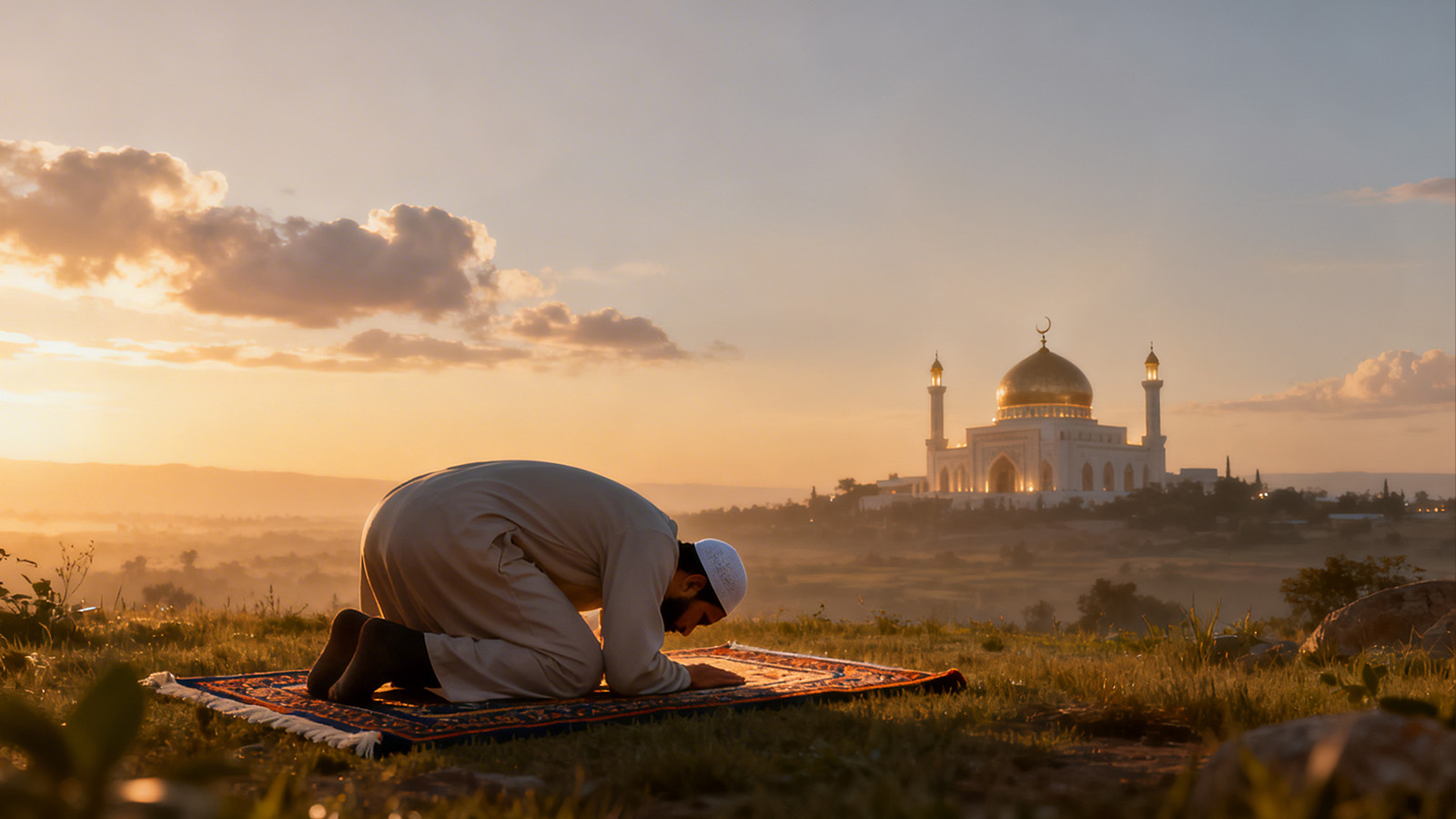
This worship is not limited to ritual acts, though those are central. Five times a day, Muslims bow, prostrate, and recite words of praise and supplication. This ritual prayer (salat) is a reminder, a purification, and a recalibration. It affirms that no matter how scattered the day may become, the soul can return, again and again, to its centre.
But Islam goes further. Devotion is not confined to the mosque or the prayer rug. It permeates the mundane. Sleeping, eating, working, parenting, earning—all of these can become acts of devotion when done with the right niyyah (intention). A smile becomes a charity. A kind word becomes a prayer. The heart becomes a sanctuary. This is Ihsan—the excellence of living as if one sees God, and knowing that even if one cannot see Him, He sees all.
Islam differs from Bhakti traditions in significant ways. In many streams of Bhakti yoga, the devotee seeks an emotional union with the divine—sometimes even merging identities with God in ecstatic love. Islam honours love, but maintains a sacred distinction: God is not the beloved to be absorbed into; He is the Master to be obeyed, the Friend to be trusted, the Lord to be worshipped. Love is expressed not through intoxication, but through obedience. Devotion is not an escape from the world, but a sanctification of it.
This devotion is also communal. Muslims stand shoulder to shoulder in prayer, rich and poor, young and old, erasing all worldly distinctions. In the pilgrimage to Mecca (hajj), millions circle the Kaaba, wearing simple white garments, all equal before their Creator. This is not just personal piety—it is a global witness to human equality before God. Devotion, in Islam, is not only about one’s relationship with the Divine, but also about how one treats God’s creation.
The Prophet Muhammad (peace be upon him) said: “The most beloved of people to Allah are those who are most beneficial to others.” Thus, a truly devout Muslim is not only the one who prays, fasts, and recites scripture—but the one who serves, who uplifts, who forgives. Worship becomes a way of life—a life of discipline, love, and mercy.
Conclusion: The Straight Path of Steadfastness
Islam, when seen through the Living Dwij lens, is not a religion of mere rules—it is a path of steadfastness. Steadfastness in action, where one’s deeds carry eternal significance. Steadfastness in knowledge, where truth is revealed, not imagined. And steadfastness in devotion, where the heart is trained not to dissolve into the cosmos, but to bow before the Creator in love and reverence.
It does not ask for endless rebirths. It does not point inward to find divinity. It does not blur the lines between God and self. Instead, it offers something radical: a single life, a sacred test, a final reckoning, and a God who is both just and merciful.
To walk the Islamic path is to walk with clarity, conviction, and humility. It is to worship not only in moments, but in movements. It is to seek knowledge that anchors rather than intoxicates. It is to act with the awareness that this life matters—not because it will come again, but because it will not.
And in this way, Islam too calls us to be Dwij—reborn not through lifetimes, but through intention. Steadfast. Sincere. Surrendered.