Sufism: The Mystical Heart of Islam
(Based on the live discourse of Param Dwij)
(परम द्विज के प्रवचन पर आधारित)
Steadfastness in Action
Sufism is often described as an offshoot or inner stream of Islam—not because it breaks away from Islam’s foundations, but because it travels inward through them. Where outward religion may sometimes become a matter of form, Sufism insists that form must remain alive with spirit. It does not deny the obligations of Islam; it asks what those obligations are meant to do inside a human being. In that sense, Sufism turns action into an instrument of inner purification. It is not content with asking, “Did you pray?” It asks, “Did prayer soften you? Did it dismantle arrogance? Did it make you truthful, gentle, and clean in your dealings?” The Sufi sees every act as a doorway to God, but only if the ego does not hijack the act and turn it into a performance.
This is why the Sufi emphasis on action is often ascetic—not as self-torture, but as self-mastery. The early ascetics who wore coarse wool (suf) were not making a fashion statement; they were refusing luxury as an identity. Their simplicity was a protest against the soul’s addiction to comfort, praise, control, and possession. Sufism reads the human being as a battlefield of impulses: anger, greed, vanity, lust, resentment—each one a subtle idol that competes with God. The “greater struggle” (jihad al-nafs) becomes central here: an inward steadfastness that keeps returning to humility when the self wants superiority, keeps returning to patience when the self wants revenge, keeps returning to generosity when the self wants to hoard.
Yet Sufism is not only withdrawal; it is also service—because purification is incomplete if it does not ripen into compassion. Many Sufi orders historically became centres of charity, hospitality, healing, and communal cohesion. Their lodges (khanqahs, zawiyas) were not just places of meditation but shelters for travellers, the hungry, the grieving, and the lost. This is an important corrective for the spiritual seeker: the Sufi path does not end in private ecstasy; it tests itself in ordinary life. A Sufi’s “nearness to God” is measured by how safe others feel around them, how much mercy they carry into conflict, and how much integrity they maintain when no one is watching.
At the same time, it is crucial to understand the tension Sufism has often carried within the broader Muslim world. As Sufism spread across regions—from the Balkans to Africa, from Persia to India—it sometimes absorbed local practices: shrine visitation, saint veneration, poetic celebrations, musical gatherings. Many Muslims embraced these as cultural forms through which love of God could be expressed, while others criticised them as innovations that risked drifting from strict monotheistic discipline. This tension is not merely political; it reflects a deep question about religion itself: how does the infinite speak through culture without being reduced by it? The best of Sufism has historically tried to answer by staying anchored in the Qur’an and the Prophet’s example while keeping the heart awake and tender.
Steadfastness in Devotion
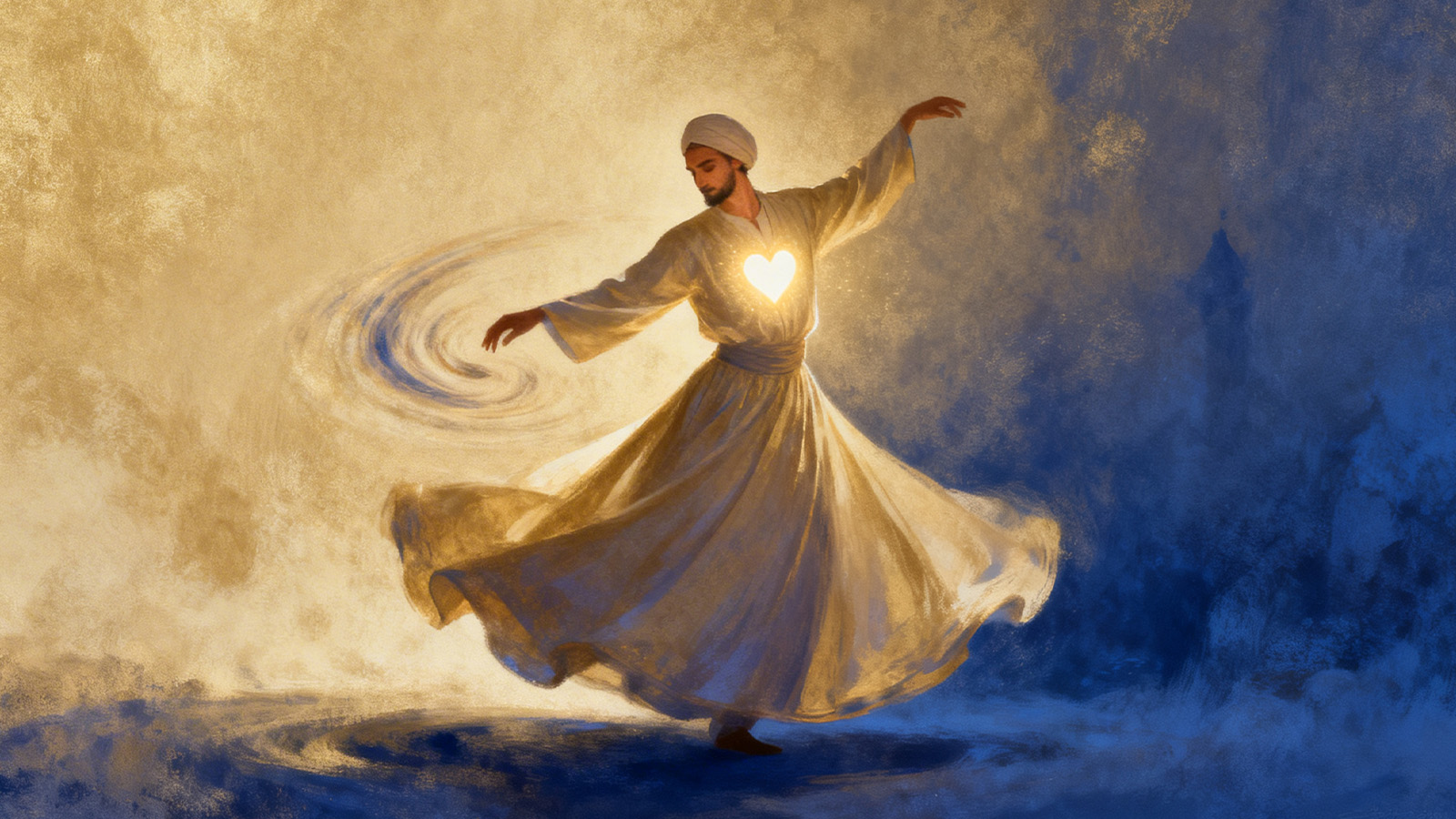
If Islam is submission, Sufism is submission that becomes love. The Sufi does not replace Islamic worship; rather, Sufism intensifies it—turning devotion from obligation into longing, from ritual into intimacy. Where a person may pray while their mind remains elsewhere, the Sufi trains to pray as if nothing exists but the One they are facing. This is why Sufism is often called “the way of the heart” (qalb). The heart, in Sufi psychology, is not merely emotional—it is the inner organ of perception. It is the place where remembrance becomes real, where the Divine presence is tasted rather than merely believed.
The central devotional practice across Sufi orders is dhikr—remembrance of God. Dhikr is not only repetition; it is reorientation. It gathers the scattered self and returns it to its centre. Some orders practise silent dhikr, refining inward attention until the name of God feels like breath itself. Others practise loud dhikr with rhythm, poetry, and communal chanting, not as entertainment but as a method of breaking the ego’s rigidity and awakening the heart’s sincerity. In both cases, the aim is the same: to move from forgetfulness to remembrance, from spiritual sleep to wakefulness, from “I” to “He.”
Sufi devotion also develops through the relationship with a spiritual guide (murshid or shaykh). This can be misunderstood in modern contexts as blind following, but the classical Sufi logic is subtler: the ego is a sophisticated deceiver, and the seeker often cannot detect their own self-deception. The guide is meant to mirror the seeker’s blind spots and keep the journey from becoming fantasy. Ideally, the teacher does not replace God; the teacher returns the seeker to God. This is why authentic Sufi lineages stress adab—spiritual etiquette, humility, sincerity, and restraint. Devotion without discipline becomes intoxication; discipline without devotion becomes dryness. Sufism tries to hold both.
At the peak of devotional life lies a Sufi ideal often described through two interlinked states: fanā and baqā. Fanā refers to the dissolving of the ego’s dominance—the fading of the false self that constantly demands attention, security, and superiority. Baqā refers to “abiding”—the return to the world with a new kind of selfhood, where the seeker acts, loves, and serves without being owned by selfish desire. This is why the Sufi does not seek escape from life; they seek a transformed way of being within life. They want to remain in the world, but no longer be imprisoned by it.
And here Sufism becomes one of Islam’s most powerful languages of compassion. In many of its most luminous expressions, it refuses hatred as a spiritual path. It treats mercy as the signature of proximity to God. Its poets and saints often speak of God not as distant judge alone, but as Beloved—so near that the seeker begins to feel ashamed not of sin as a legal violation, but of sin as a betrayal of love. This does not erase accountability; it deepens it. The Sufi repents not only because punishment is feared, but because separation from God is unbearable.
Steadfastness in Knowledge
Sufism is frequently misunderstood as being “beyond knowledge,” as if it is purely emotional mysticism. In reality, Sufism is deeply invested in knowledge—but it distinguishes between kinds of knowing. There is the knowledge that fills the mind, and there is the knowledge that changes the being. A Sufi does not reject scholarship; the tradition produced towering thinkers, theologians, philosophers, and Qur’anic interpreters. But it insists that knowledge becomes incomplete if it does not culminate in transformation. The Qur’an, for Sufis, is not merely a text to be analysed; it is a mirror to be entered. Interpretation becomes a spiritual act because the purpose of reading is not to win arguments, but to awaken the soul.
This is why Sufi hermeneutics often speaks of the Qur’an having layers—an outer meaning (zahir) and an inner meaning (batin). The outer meaning anchors the believer in law, ethics, worship, and creed. The inner meaning opens the heart to spiritual realities such as sincerity, reliance, humility, purification, and Divine love. The Sufi claim is not that the inner meaning cancels the outer. Rather, the inner meaning is what makes the outer meaning alive. Without the heart, religion becomes a body without breath.
Historically, this approach produced a rich exegetical tradition. Sufi commentators explored how verses that appear legal or historical also carry inner instruction—guidance on the states of the heart, the diseases of the ego, the methods of repentance, and the subtleties of intention. In many Sufi writings, especially poetry, knowledge becomes experiential language. Rumi’s Masnavi, often called “the Qur’an in Persian” in popular reverence, is an example of how story, metaphor, and beauty can become vehicles for spiritual instruction. The Sufi mind recognises that the deepest truths cannot always be captured by dry abstraction; sometimes truth needs symbol to enter the heart.
At the same time, Sufism’s relationship with “oneness” needs careful articulation. Many Sufis speak of unity—of all existence being held in God’s reality, of separation being a kind of illusion created by ego. Some interpret this through the philosophical language of wahdat al-wujud (unity of being), which has sparked debate among Muslims for centuries. In its healthiest form, Sufi unity does not claim that the human becomes God in a literal sense; rather, it points to a spiritual perception: that everything depends on God, that nothing exists independently, and that the ego’s sense of separateness is the root of fear, hatred, and arrogance. This is not a license for theological confusion; it is an attempt to describe what happens when the heart becomes so saturated with remembrance that the world is seen as sign, not rival.
Sufism also carries a distinctive stance toward other faiths in many of its historical expressions. Some Sufi teachers guided non-Muslims without coercing conversion, emphasising transformation of character and sincerity of devotion. This has been celebrated as spiritual inclusivity and criticised as theological dilution, depending on who is speaking. What remains essential, however, is the Sufi principle that the work is inner: purify the heart, polish the mirror, and then whatever you call God—if you are sincere—will not remain a mere idea. Yet within Islam itself, many Sufis maintain that their path is not outside the Prophet’s way but an intensification of it: Sharia as foundation, Tariqa as method, Haqiqa as realised truth. In other words, knowledge begins with revelation, deepens through discipline, and culminates in lived certainty.
Closing Reflection in the Living Dwij Lens
Seen through the Living Dwij frame, Sufism reads like a sacred insistence that spirituality must not become a costume. It demands steadfastness in action so that the ego cannot pretend to be pure while it remains cruel, greedy, or dishonest. It demands steadfastness in devotion so that worship becomes presence rather than habit. And it demands steadfastness in knowledge so that the mind’s learning turns into the heart’s illumination. The Sufi is not trying to become special; the Sufi is trying to become empty enough for the Real to be felt.
If Islam is the straight path of surrender, Sufism is the inner art of walking that path with love. It is not a different destination, but a different depth. It is the same prayer—but prayed as a longing. The same scripture—but read as a mirror. The same obedience—but purified of ego. And in that purification, what remains is the simplest, most difficult truth: the heart was made for God, and it will not rest until it returns.