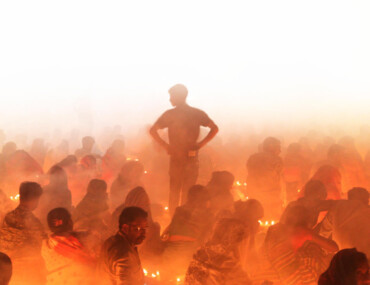
The Sacred Art of Returning: Navigating the Spiral Path of Spiritual Evolution
(Based on the live discourse of Param Dwij)
(परम द्विज के प्रवचन पर आधारित)

Param Dwij says:
“You are not meant to go higher, only deeper. And when you think you’ve fallen, you are merely returning to what is real.”
I. The Illusion of Linear Progress
One of the great myths of the modern spiritual journey is that it is linear — a straight path from ignorance to awakening, darkness to light, pain to bliss. We picture it as a staircase, with each step representing a breakthrough, clarity, and transcendence. We expect that once we’ve “worked through” something — a fear, an old pattern, a childhood wound — it should be done, resolved, mastered. And when it returns, when old feelings resurface, or we relapse into confusion, we call it a setback.
But what if it’s not a setback?
What if it’s a spiral?
In the Living Dwij philosophy, spiritual growth is never a straight ascent. It is a spiral unfolding — a pattern of returning, remembering, relearning. You revisit the same themes not because you failed to heal them, but because you are now ready to meet them at a deeper layer. Each cycle down is actually a movement inward — into a subtler truth, a finer frequency of awareness.
To grow spiritually does not mean you stop feeling anger, fear, loneliness, or doubt. It means your relationship to those emotions changes. You stop identifying with them. You begin witnessing them. You stop reacting and start responding. You stop pushing them away and begin welcoming them as guests — messengers of deeper knowing.
Param Dwij says:
“You do not become immune to pain. You become intimate with it — until even pain bows to presence.”
II. The Seasonality of the Soul
Every living being honours cycles. Trees do not bloom all year. The moon disappears before it shines again. Even the breath has its own tide — inhale, exhale, pause. But human beings — conditioned by productivity culture — have come to fear stillness, darkness, and waiting. We pathologise pause. We judge dormancy. We chase perpetual clarity as if confusion has no place on the path.
But to Live Dwij is to remember that every soul has seasons. There are times of blossoming and times of burial. There are days of insight, and nights of forgetting. None of these are wrong. None of these makes you unspiritual. What matters is not how bright you feel, but how honestly you meet the moment.
Stillness is not failure. Confusion is not regression. The fog is often a sign that something deeper is germinating underground. Let yourself rest when rest calls. Let yourself unravel when clarity feels forced. Let the sacred timing of your own soul become the rhythm you trust most — not the performance of enlightenment, not the outer metrics of “progress.”
III. The Discomfort of Consciousness
As you deepen on the path, it is tempting to think life will become easier — that your inner work will shield you from conflict, that your peace will immunise you from pain. But in truth, the opposite often happens.
To become more conscious is to become more sensitive. You notice the falseness in conversations. You feel the dissonance in relationships. You can no longer tolerate what you used to numb out. The more aware you become, the less you can pretend. This is not a curse. It is a calling. The discomfort is not a punishment — it is a purification. It is life stripping away the layers that no longer fit your frequency.
Param Dwij says:
“Growth does not always feel like expansion. Sometimes it feels like loss — because illusions are being peeled away.”
You will grieve your old self. The version of you who tolerated more, pleased more, conformed more. You will lose friends, identities, and roles that no longer match your vibration. And in that loss, you will discover something deeper: presence without performance. A peace that isn’t dependent on perfection.
Spiritual maturity is not about always being calm. It is about knowing how to return. It is about recognising when you are in a story and breathing yourself back into truth.
IV. The Sacred Technology of Return
The spiral path invites one core question again and again:
How do I return when I forget?
Not how do I escape? Not how do I fix? But how do I remember what I truly am — amidst the mess, the confusion, the old patterns reawakening? This is where Living Dwij becomes a living practice. A return to self, again and again. Not through effort. But through orientation.
Here are a few gentle ways to practice returning:
- The Body as Anchor
When the mind is noisy, drop into the body. Place your hand on your chest. Feel the breath rise and fall. Notice your feet. Return to sensation. The body never lies. - Naming Without Narrative
Instead of spiralling into meaning, simply name what is arising. “I notice shame.” “I feel contraction.” “There is fear here.” You are not the fear. You are the awareness witnessing it. - Rest Without Rescue
You don’t have to rescue yourself from every emotion. Sometimes presence is the medicine. Allow the ache to exist. Let your breath wrap around it like a warm blanket. - Speak to the Self
Say gently: “Even now, I choose to return. Even here, I am held. Even in this forgetting, I am not forsaken.”
This is the sacred technology of return — simple, subtle, profound. You do not need a ritual, a chant, or a posture. You only need sincerity. And that sincerity will guide you home.
V. The Compassion of the Path
Perhaps the most radical shift in spiritual evolution is the replacement of judgment with compassion. Early on, we judge ourselves for every misstep. We try to “do” the path right. We try to become worthy of peace.
But slowly, we realise: We were never outside the path. We were never off track. We were walking in circles, spirals, seasons — all held in the same sacred field. The more you grow, the more tender you become. Not because you’ve lost strength — but because you’ve redefined strength. You learn to forgive yourself faster. To return without shame. To let softness replace self-hate. To welcome the wounded inner child not as a problem, but as a portal.
Param Dwij says:
“There is no enlightenment without tenderness. The soul ripens through compassion, not conquest.”
Let this be your practice: When you fall, fall kindly. When you forget, return softly. When you remember, bow humbly. The journey was never meant to be perfect. Only real.
VI. Living the Spiral with Grace
To live as a Dwij — one who is twice-born — is to understand that life will keep inviting you back to yourself. Again and again. In different disguises, through different pains, with deeper stakes. You will revisit the same fears, not because you failed — but because you’re ready to meet them with more presence. You will feel old wounds, not because they never healed — but because they now ask for integration, not avoidance. You will question everything you thought you knew, not to collapse — but to make space for a vaster knowing. This is the spiral. This is the path. This is the grace beneath the confusion.
Closing Reflection
“You do not graduate from your humanity. You sanctify it.
You do not erase your patterns. You hold them in presence.
You do not climb to the Divine. You sink into it — right here, right now, in the mess, the magic, and the moment.”
— Param Dwij